After traveling for two years and billions of kilometers from Earth, the OSIRIS-REx probe is only a few months away from its destination: the intriguing asteroid Bennu. When it arrives in December, OSIRIS-REx will embark on a nearly two-year investigation of this clump of rock, mapping its terrain and finding a safe and fruitful site from which to collect a sample.
The spacecraft will briefly touch Bennu’s surface around July 2020 to collect at least 60 grams (equal to about 30 sugar packets) of dirt and rocks. It might collect as much as 2,000 grams, which would be the largest sample by far gathered from a space object since the Apollo Moon landings. The spacecraft will then pack the sample into a capsule and travel back to Earth, dropping the capsule into Utah’s west desert in 2023, where scientists will be waiting to collect it.
This years-long quest for knowledge thrusts Bennu into the center of one of the most ambitious space missions ever attempted. But the humble rock is but one of about 780,000 known asteroids in our solar system. So why did scientists pick Bennu for this momentous investigation? Here are 10 reasons:
1. It’s close to Earth
Unlike most other asteroids that circle the Sun in the asteroid belt between Mars and Jupiter, Bennu’s orbit is close in proximity to Earth’s, even crossing it. The asteroid makes its closest approach to Earth every 6 years. It also circles the Sun nearly in the same plane as Earth, which made it somewhat easier to achieve the high-energy task of launching the spacecraft out of Earth’s plane and into Bennu’s. Still, the launch required considerable power, so OSIRIS-REx used Earth’s gravity to boost itself into Bennu’s orbital plane when it passed our planet in September 2017.
2.It’s the right size
Asteroids spin on their axes just like Earth does. Small ones, with diameters of 200 meters or less, often spin very fast, up to a few revolutions per minute. This rapid spinning makes it difficult for a spacecraft to match an asteroid’s velocity in order to touch down and collect samples. Even worse, the quick spinning has flung loose rocks and soil, material known as “regolith” — the stuff OSIRIS-REx is looking to collect — off the surfaces of small asteroids. Bennu’s size, in contrast, makes it approachable and rich in regolith. It has a diameter of 492 meters, which is a bit larger than the height of the Empire State Building in New York City, and rotating once every 4.3 hours.
3. It’s really old
Bennu is a leftover fragment from the tumultuous formation of the solar system. Some of the mineral fragments inside Bennu could be older than the solar system. These microscopic grains of dust could be the same ones that spewed from dying stars and eventually coalesced to make the Sun and its planets nearly 4.6 billion years ago. But pieces of asteroids, called meteorites, have been falling to Earth’s surface since the planet formed. So why don’t scientists just study those old space rocks? Because astronomers can’t tell (with very few exceptions) what kind of objects these meteorites came from, which is important context. Furthermore, these stones, that survive the violent, fiery decent to our planet’s surface, get contaminated when they land in the dirt, sand, or snow. Some even get hammered by the elements, like rain and snow, for hundreds or thousands of years. Such events change the chemistry of meteorites, obscuring their ancient records.
4.It’s well preserved
Bennu, on the other hand, is a time capsule from the early solar system, having been preserved in the vacuum of space. Although scientists think it broke off a larger asteroid in the asteroid belt in a catastrophic collision between about 1 and 2 billion years ago, and hurtled through space until it got locked into an orbit near Earth’s, they don’t expect that these events significantly altered it.
5. It might contain clues to the origin of life
Analyzing a sample from Bennu will help planetary scientists better understand the role asteroids may have played in delivering life-forming compounds to Earth. We know from having studied Bennu through Earth- and space-based telescopes that it is a carbonaceous, or carbon-rich, asteroid. Carbon is the hinge upon which organic molecules hang. Bennu is likely rich in organic molecules, which are made of chains of carbon bonded with atoms of oxygen, hydrogen, and other elements in a chemical recipe that makes all known living things. Besides carbon, Bennu also might have another component important to life: water, which is trapped in the minerals that make up the asteroid.
6. It contains valuable materials
Besides teaching us about our cosmic past, exploring Bennu close-up will help humans plan for the future. Asteroids are rich in natural resources, such as iron and aluminum, and precious metals, such as platinum. For this reason, some companies, and even countries, are building technologies that will one day allow us to extract those materials. More importantly, asteroids like Bennu are key to future, deep-space travel. If humans can learn how to extract the abundant hydrogen and oxygen from the water locked up in an asteroid’s minerals, they could make rocket fuel. Thus, asteroids could one day serve as fuel stations for robotic or human missions to Mars and beyond. Learning how to maneuver around an object like Bennu, and about its chemical and physical properties, will help future prospectors.
7. It will help us better understand other asteroids
Astronomers have studied Bennu from Earth since it was discovered in 1999. As a result, they think they know a lot about the asteroid’s physical and chemical properties. Their knowledge is based not only on looking at the asteroid, but also studying meteorites found on Earth, and filling in gaps in observable knowledge with predictions derived from theoretical models. Thanks to the detailed information that will be gleaned from OSIRIS-REx, scientists now will be able to check whether their predictions about Bennu are correct. This work will help verify or refine telescopic observations and models that attempt to reveal the nature of other asteroids in our solar system.
8. It will help us better understand a quirky solar force …
Astronomers have calculated that Bennu’s orbit has drifted about 280 meters (0.18 miles) per year toward the Sun since it was discovered. This could be because of a phenomenon called the Yarkovsky effect, a process whereby sunlight warms one side of a small, dark asteroid and then radiates as heat off the asteroid as it rotates. The heat energy thrusts an asteroid either away from the Sun, if it has a prograde spin like Earth, which means it spins in the same direction as its orbit, or toward the Sun in the case of Bennu, which spins in the opposite direction of its orbit. OSIRIS-REx will measure the Yarkovsky effect from close-up to help scientists predict the movement of Bennu and other asteroids. Already, measurements of how this force impacted Bennu over time have revealed that it likely pushed it to our corner of the solar system from the asteroid belt.
9. … and to keep asteroids at bay
One reason scientists are eager to predict the directions asteroids are drifting is to know when they’re coming too-close-for-comfort to Earth. By taking the Yarkovsky effect into account, they’ve estimated that Bennu could pass closer to Earth than the Moon is in 2135, and possibly even closer between 2175 and 2195. Although Bennu is unlikely to hit Earth at that time, our descendants can use the data from OSIRIS-REx to determine how best to deflect any threatening asteroids that are found, perhaps even by using the Yarkovsky effect to their advantage.
10. It’s a gift that will keep on giving
Samples of Bennu will return to Earth on September 24, 2023. OSIRIS-REx scientists will study a quarter of the regolith. The rest will be made available to scientists around the globe, and also saved for those not yet born, using techniques not yet invented, to answer questions not yet asked.
Read the web version of this week’s “Solar System: 10 Things to Know” article HERE.
Make sure to follow us on Tumblr for your regular dose of space: http://nasa.tumblr.com.
Water droplets create amazing human-like animations. Gatorade built this technology from scratch just for an ad. 2,500 switches turn the water on and off, and motion capture tells it what to do. The results are incredible. (Source)
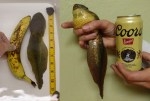
A record-breaking, 10-inch-long whopper of a bullfrog tadpole was discovered by a crew of ecologists in a pond in Arizona.
The biggest tadpole ever found—at a whopping 10 inches long—was discovered
by a crew of ecologists in a pond in the Chiricahua Mountains of Arizona. Alina Downer, an intern at the American Museum of Natural
History’s Southwestern Research Station, came across the monster
bullfrog tadpole as her crew was draining a manmade pond as part of a
habitat restoration project for the endangered Chiricahua leopard frog.
As the water level lowered, Downer
and her colleagues were assessing what organisms were left in the muddy
shallows that she likened to “chocolate soup.” Downer says, “I was
fishing around with my hands while walking in the water, and I felt
something large, smooth, and wriggly—which was unexpected, since the
only other fish in the pond were about an inch long.”
As
an avid naturalist, Downer’s first instinct was curiosity. “At first I
thought it was a giant catfish,” she says, grinning at the uncanny
memory. “Whatever it was, I knew I had to grab it.” She herded the slippery creature into shallower water until she could capture it. To her surprise, it turned out to be “an enormous monster of a tadpole”—so
big she had to hold it with two hands…
Not to undervalue at all the coolness of this discovery but I feel like the above quote is a valuable supporting evidence of field biologists intrinsically possessing diminished survival instincts and higher numbers of cool scar stories.
Hello friends, I’m going to tell you some cool stuff about bees and why you shouldn’t be afraid of them!
See, there is a lot of misplaced fear over our fuzzy pollinating buddies. Many folks think they are mean and dangerous, but bees are very good little friends. The little, kind bee should not be mistaken for their evil look a likes, such as Hornets Yellow Jackets and Wasps, which are evil and should be hated like the beasts they are. Bees are docile by nature, and are not a threat to anyone who’s not allergic to them.
These bees are Swarming, which despite it’s scary sounding name, is not a dangerous time to be around bees. This time is the safest time to be around bees because they couldn’t give a hoot about you. These bees are gathering themselves together in order to go as a whole colony to find a new home. The gif is showing how bees don’t mind the outside world at this point in a swarm. The bees probably feel like a tickle on his hand. ^-^
Here’s some cool facts about bees!
-Bees are the BEST pollinators in the world! better than butterflies, or humming birds.
-Bees in a colony are all females. The males of the species look totes different and are called drones.
-Bees are totally different from Yellow Jackets, Hornets, and Wasps. They are not even close relatives in the insect kingdom!
-“Africanized” Bees are of no threat to anyone north of the New Mexico, and they barely pose a risk there! They are more territorial than some other species of bees, but not as bad as wasps.
-Many crops rely on bees.
-Bees will often die after stinging someone. Bees know this, and thus will do much to avoid stinging you. Hate to say it buddy, but you’re not worth their time.
-Honey, in it’s natural state, is a vitamin rich superfood! It can help with everything from icky feelings, to gross hair.
-Bees are threatened in many places by parasites, people, and misinformation. Do your part to help the bees and plant some flowers.
sorry if i’m being a party pooper but because rabies is apparently the new joke on here ??? please remember that rabies has an almost 100% fatality rate after symptoms develop so if you’re bitten or scratched by an animal that you aren’t 100% sure is vaccinated then GO TO A DOCTOR. it’s not a joke. really.
One of the most mesmerizing things about online communities, is when spending enough time with like-minded people, the facts and consequences of reality begin to melt away.
Suddenly, rabies isn’t as dangerous as everyone says, the earth is flat, the moon landing was faked, and Steven Universe kin drama is a legitimate threat.
that’s a good way of putting it. while thinking abt making this post i kept thinking “i’m afraid this is gonna end up like the tide pod thing” but didn’t know how to articulate it so thank you for that
I mean usually I’d say people need to go outside, but I fear if they’re rabies fetishists that’s the exactly what they want
I need to emphasize: Rabies does not have an “almost” 100% fatality rate. Rabies has a 100% fatality rate, period. Ebola has a fatality rate of about 50%. There are six people in recorded history who have ever contracted rabies and survived. Six. Six human beings. Ever.
The fatality rate of attempted suicide with a firearm is 82.5%.
All six of those people were complete flukes. They’re outliers. We haven’t been able to figure out how to recreate whatever the hell it was that saved them and not anyone else. If you are exposed to rabies, and don’t immediately receive intensive post-exposure treatment, you die. Not “probably” die, not “it’s as good as a death sentence”. You are dead. There is no remote fractional percentage of a chance that you will not die. It’s terrifying and painful and ugly. It’s not a way anyone in this world deserves to die.
If you’re not sure whether something was rabies exposure, go to the fucking hospital to be sure, because by the time rabies symptoms begin to manifest, treatment is no longer an option. By the time you suspect you have rabies, it is far, far too late. By the time you start showing symptoms, there’s…nothing that anyone can do anymore.
At that point, the only option is called the Milwaukee Protocol, which, again….we’ve NEVER created an effective, reliable way of treating rabies once it manifests. In practice, it mostly consists of putting you in a medically induced coma–not in any real hope of saving your life, but to spare you the pain of feeling what happens to youwhile you die of rabies.
I genuinely have no idea to what extent rabies has become an actual joke on the internet or if it’s just that one guy who so help me god had better be some kind of satire, but…rabies is fucking terrifying. “Possible rabies exposure” is one of the scariest phrases I can think of.
None of this is fearmongering. Don’t fuck around with rabies.







 The Perfect Scientist